Review · ZAGORA
Desert Trail in Morocco on Horseback
The Sahara is best seen at a horse’s pace. This six-day ride from Zagora takes you through Tuareg villages, the Draa palm grove, desert dunes, rocky plains, and the dramatic Jebel Bani. I like the small group size, capped at 10 people, and the fact that meals, lodging, airport transfers, horses, guides, and private transport are included. I also like the clear sense of place: this is not a quick camel photo stop, but a long ride through southern Morocco with time to cross villages and open desert.
The main catch is the daily riding time. Most days run about eight hours, so you need to be comfortable in the saddle and ready for heat, dust, and changing ground. The price of $234.91 per person is attractive for six days of meals and lodging, but the required 10 percent tip is extra, and the non-refundable booking policy calls for careful planning.
Key details to know before booking
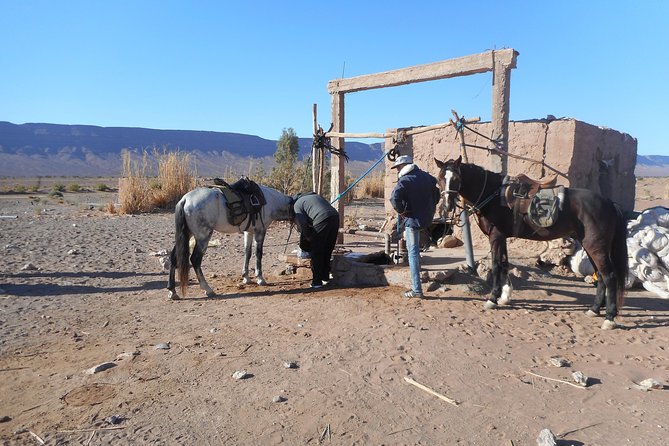
- Six days on Arab Berber horses: You ride daily, with the final day lasting about six hours.
- Two very different desert areas: The route begins around Tameghourte and the Draa Valley, then moves into dunes, rocky desert, and the Jebel Bani range.
- A maximum of 10 people: This keeps the group personal and makes it easier for the guide to manage riders and horses.
- Five nights of accommodation: Breakfast, lunch, and dinner are supplied, along with afternoon tea.
- Airport pickup in Zagora: Your listed meeting point is Zagora Airport at 10:00 a.m., with transport to the horses.
- A serious riding holiday: Most days are about eight hours, so this suits people who want a real trail ride rather than a short horseback outing.
A six-day ride through Morocco’s southern desert
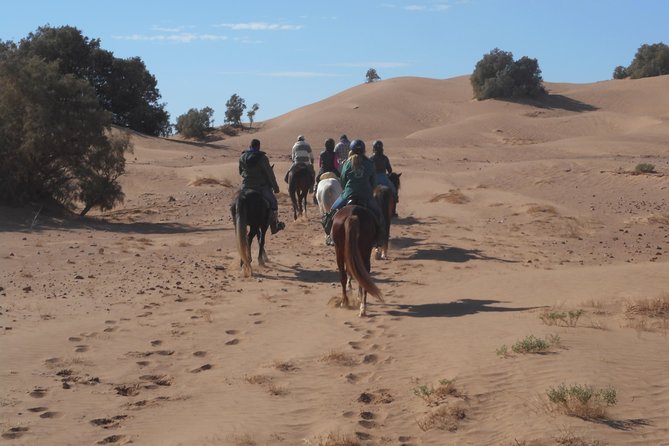
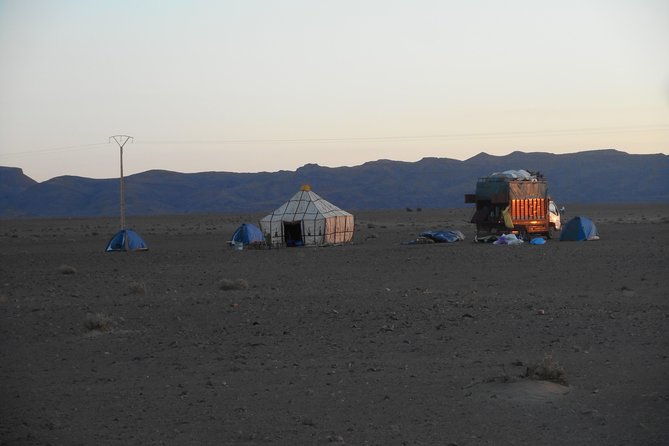
This experience is built around a simple idea: let the horse carry you through the desert at a human pace. You do not rush from one photo stop to the next. Instead, you cross a Tuareg village, pass gardens and old Moroccan castles, follow a river, enter the Sahara, and approach mountain country.
The route has two main moods. The first is the Draa Valley near Tameghourte, where palm trees and small gardens soften the dry surroundings. The second is the open desert around Tagounite, M’Hamid, and Jebel Bani, where the scenery becomes more spare and dramatic.
I like that contrast. You get a better sense of southern Morocco than you would from a single desert camp. You also see how settlements survive beside palms, water, and old fortified structures before riding into broad stretches of sand and rock.
The experience is described as suitable for all ages and skill levels. Still, that needs a practical reading. A beginner may be welcome, but eight hours in the saddle is a long day for anyone. Your comfort, balance, and ability to follow the guide matter more than your technical riding background.
More Desert Horse Riding in Morocco
- Agadir: Forest and Sand Dunes Guided Horse Riding
★ 4.4 · 278 reviews - Marrakech: Desert and Palmeraie Horse Riding Tour & Transfer
★ 4.8 · 221 reviews - Agadir Sinec Canyon Desert Tour + Optional Sandboarding
★ 4.8 · 193 reviews
Day 1: From Zagora Airport to the first desert camp
The trip begins at Zagora Airport at 10:00 a.m. A taxi takes the group to the horses, where you meet your mount and prepare to ride. The first stage crosses a Tuareg village, offering an immediate look at local life before the route opens into wider countryside.
The day includes several types of scenery, a lunch stop, and an afternoon crossing of a river before reaching the camp. The full day is listed at about eight hours, so the transfer from the airport is not a slow morning followed by a short ride. You should be ready to get organized and spend most of the day outdoors.
This is a useful first day because it eases you into the region through settlement and countryside rather than dropping you straight into empty sand. You begin to see how villages, palms, gardens, and desert edges fit together.
The practical issue is timing. Airport pickup sounds convenient, but you should have your passport details and booking information in order before arrival. The operator requires each participant’s passport name, number, expiry date, and country of issue at booking.
Day 2: Tagounite and the open desert
The second day centers on Tagounite and its surrounding desert scenery. The description is brief, but that is part of the appeal of this stretch. You spend the day moving through broad, dry country rather than collecting a long list of formal attractions.
For you, the value comes from the steady rhythm of the ride. Open desert gives you space to watch the horses, read the ground, and notice small changes in color and texture. Some sections may be sandy, while others may be harder and rockier. The route later confirms that the ride includes both dunes, known as erg, and stony desert, known as reg.
This is also where the eight-hour schedule may become real. A long day in the saddle can feel very different from a one-hour riding excursion. Afternoon tea is included, and breakfast, lunch, and dinner are supplied throughout the trip, which removes much of the daily planning.
You should still advise the operator about dietary needs when booking. A vegetarian option is available, but it needs to be requested in advance.
Day 3: Jebel Bani appears like a desert canyon
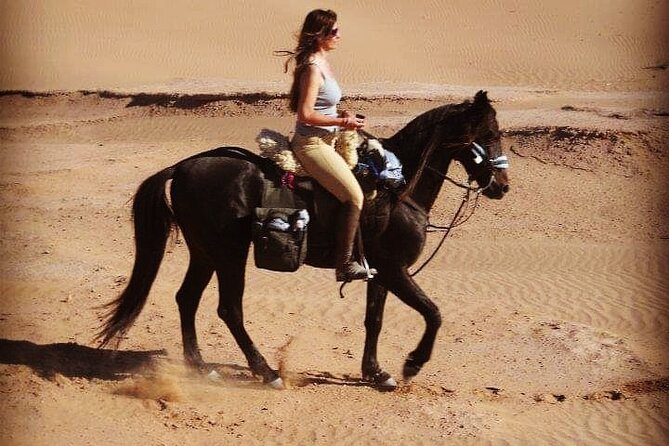
On the third day, the ride approaches the lower part of Jebel Bani. The description compares the mountain setting to a canyon in the Sahara, which gives you a useful picture of the change ahead. After two days of more open desert, the rock formations create a stronger sense of enclosure.
Jebel Bani is one of the most memorable parts of the route because it breaks the common image of Morocco as nothing but dunes. The desert here includes mountains and rocky ground, and the horse gives you a slow, steady way to take in the change.
I would treat this as a scenic day rather than a sightseeing day with many stops. The supplied plan does not list museums, monuments, or scheduled visits. The ride itself is the activity, and the reward is the changing terrain.
If you prefer a packed schedule of attractions, this may feel quiet. If you enjoy long stretches outdoors and broad views, it should feel more satisfying.
Same saddle, a different kind of ground:
- Marrakech: Private Horseback Tour in the Palm Grove with Tea
★ 4.8 · 1,092 reviews - Agadir and Taghazout: 2-Hour Horseback Ride on the Beach
★ 4.6 · 888 reviews - From Marrakech: Atlas Mountains 45-Minute Horseback Ride
★ 4.6 · 327 reviews - From Essaouira: 1-Hour Horse Ride
★ 4.9 · 243 reviews
Day 4: Entering M’Hamid on horseback
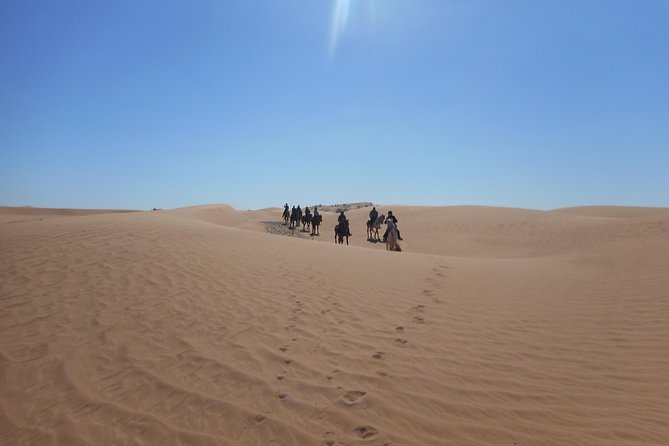
Day four brings you to M’Hamid, described as an old Sahara city with the feel of a Western film. That image is easy to understand: arriving on horseback gives the town a different character than arriving by car or bus.
M’Hamid is also an important point in the route because it connects settled Morocco with the deeper desert. You are not simply riding around a resort area. The journey moves through an older desert town before continuing toward the larger open spaces of the Sahara.
This should be one of the easier days to remember because the arrival itself is part of the experience. Your horse becomes the way you enter the town, not just transport between camps.
The plan still lists about eight hours, so do not assume the town visit is a short afternoon stop. Exact rest periods and time in M’Hamid are not specified. Your guide controls the pace, and the group travels together.
Day 5: Crossing the largest part of Jebel Bani
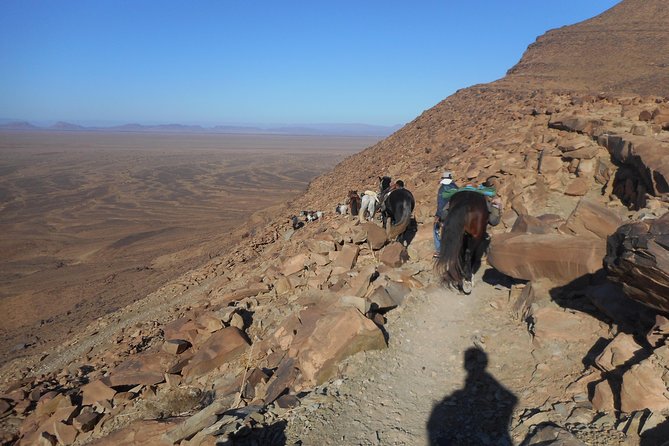
The fifth day is the mountain day. You cross the largest part of Jebel Bani, ride upward, stop for a magnificent view, then descend toward camp.
This is likely the most demanding part of the route. Going uphill on horseback requires attention from both rider and animal, and the descent calls for a calm pace. The description does not give technical riding grades or distances, so you should not assume that every section is easy.
The reward is the view from higher ground. From the mountain, you can see the desert in a wider way, with rock, sand, and distant horizons connected in one sweep. It is a strong contrast with the lower, flatter stretches around Tagounite and M’Hamid.
I like the way this day gives the six-day trip a real high point. You are not simply repeating the same trail beside the same dunes. The terrain changes, and the ride asks more from you.
Day 6: Final gallops and the return to Zagora
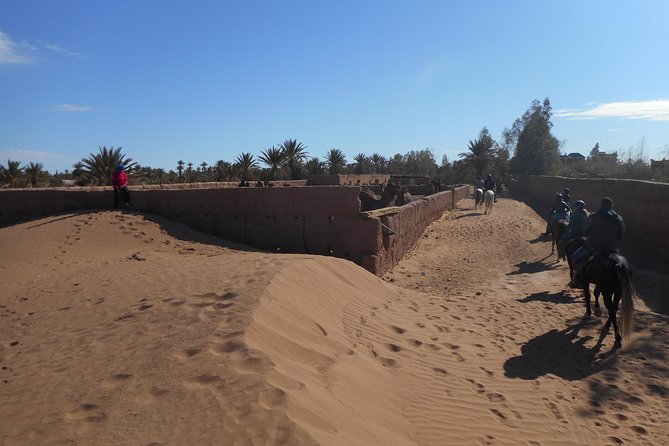
The final day lasts about six hours and includes the last stretches on horseback with the Arab Berber horses. The plan describes a chance for final gallops before saying goodbye and taking a flight back.
That wording suggests a faster finish, but your pace will depend on the guide, the horses, and the group. You should not expect a private riding lesson or guaranteed fast gallop. The tour description does present the horses as gentle, which may help less experienced riders feel more at ease.
The day ends back at the meeting point. Airport pickup and drop-off in Zagora are included, and the activity ends at the original meeting point. You will want to confirm your flight timing directly with the operator because the exact return schedule is not provided.
What the price includes, and what it does not
At $234.91 per person, the cost is strong for a six-day experience if you value riding time over luxury. The package includes five nights of accommodation, six breakfasts, six lunches, five dinners, afternoon tea, a guide, Arab Berber horses, airport transfers, and transport by private vehicle.
That is a lot of coverage for the listed price. You do not need to arrange separate meals each day or hire local transport between the airport and the trail. The small group limit also adds value, since a maximum of 10 riders is more manageable than a large coach-style tour.
The price is not fully all-in. Tips equal to 10 percent of the entire travel package are not included. You should add that amount to your personal budget before deciding what the trip really costs.
Accommodation details are limited. Five nights are included, but the information does not specify room type, hotel standard, or the exact style of camp. If you need a private room, a certain mattress standard, or particular bathroom facilities, ask before paying.
The same applies to meals. Breakfast, lunch, dinner, and afternoon tea are included, but menus are not described. Vegetarian food is available if requested in advance.
The horses, guide, and group size
The horses are Arab Berber horses, and the trip presents them as gentle. That is encouraging for riders who have some experience but do not want an intense or technical horse trek.
You should still remember that horses are living animals, not vehicles with an automatic setting. Follow the guide’s instructions, keep a safe distance between horses, and be prepared for the ride to change with the ground and weather.
The guide may be multilingual. That can be helpful in a mixed group, though the specific language support is not stated. The operator is Ranch De Diabat S.A.R.L., which also offers riding experiences in Morocco.
The two available ratings praise the hosting team in very warm terms. One account describes exceptional care, humor, and kindness on a week-long horse trek along Morocco’s Atlantic coast. Another describes Ranch de Diabat as a trusted family connection and notes repeated riding treks with the company since 2018. Those comments concern the company’s riding work more broadly, not specific details of this Zagora route, but they point to a personal, care-focused style.
A group maximum of 10 makes that style more possible. You can expect a smaller riding group, not a huge line of horses stretching across the desert.
Who should book this desert ride?
I would choose this experience if you want the riding itself to be the heart of your Morocco trip. It fits someone who enjoys long outdoor days, simple desert accommodation, local scenery, and a steady pace.
It may suit a mixed-age group, since the experience is presented as appropriate for all ages and skill levels. But daily duration matters more than the label. An older child or beginner might participate, while someone who dislikes long periods in the saddle may struggle.
You should also be comfortable with limited detail before departure. The route is clear at a broad level, but the accommodation type, exact daily distances, and riding skill requirements are not fully explained.
This is not the right choice if you want a short, polished excursion with guaranteed hotel comfort and a fixed list of attractions. It is also a poor match if you need flexible cancellation. The booking is non-refundable and cannot be changed for any reason.
Practical preparation for six days in the Sahara
Wear practical smart-casual clothing, as requested by the operator, with layers suitable for changing desert conditions. The exact weather information is not supplied, so you should ask what clothing and riding equipment are recommended for your dates.
Plan for long exposure to sun, wind, dust, and dry air. The tour supplies meals and afternoon tea, but the included personal equipment is not listed. Ask what you need to bring for riding, sleeping, luggage, and personal comfort.
Keep your booking details accurate. Passport name, number, expiry date, and country are required for every participant. Dietary requirements should be sent at booking, and vegetarian meals are available with advance notice.
The booking confirmation is expected within 48 hours, subject to availability. Since the experience is non-refundable, wait until your flights and schedule are secure before paying.
Should you book the Desert Trail in Morocco on Horseback?
Book it if you want a real, multi-day horse trek through southern Morocco and you like the idea of moving from palm groves and villages to dunes, rocky desert, and mountain passes. The included meals, airport transfers, private transport, and small group make the $234.91 price look appealing, even after adding the 10 percent tip.
Skip it if you want luxury, short riding sessions, or easy changes after booking. The eight-hour days are the biggest test, and the accommodation details deserve clarification before you commit.
For the right rider, this is a rare chance to see the Draa Valley, M’Hamid, and Jebel Bani as part of one connected journey. You ride into the Sahara instead of merely visiting it, and that is the trip’s real value.
FAQ
Where does the horseback tour start?
The tour starts at Zagora Airport in Morocco. The listed meeting time is 10:00 a.m.
Where does the tour end?
The activity ends back at the original meeting point, with Zagora Airport pickup and drop-off included.
How long does the tour last?
The experience lasts approximately six days and includes five nights of accommodation.
How many people can join one booking?
The maximum is 10 participants per booking and 10 travelers overall for the activity.
What meals are included?
Breakfast is included for six days, lunch is included six times, and dinner is included for five nights. Afternoon tea is also included.
Are vegetarian meals available?
Yes. A vegetarian option is available, but you need to advise the operator when booking.
Is the booking refundable?
No. The experience is non-refundable and cannot be changed for any reason.
More Guided Horseback Trail Rides in Morocco
- Los Angeles: Mulholland Trail Horseback Riding Tour
★ 4.7 · 615 reviews - Horse Sanctuary & Trail Ride in Ostia Antica
★ 4.5 · 276 reviews - Cardrona High Country Pub Trail Horse Trek (Intermediate level+)
★ 5.0 · 269 reviews - Los Angeles: 2-Hour Hollywood Trail Horseback Riding Tour
★ 4.7 · 256 reviews
Just added around Morocco
- 1 Hour Horse Riding Adventure in Ait Ben Haddou★ 5.0 · 2 reviews
- 3-hour Horseback Ride Mountain and Beach Morocco★ 5.0 · 22 reviews
- Palmeraie Grove Horse Ride 2 Hour Trip with Transfer – Marrakesh★ 5.0 · 4 reviews
- Horse Riding one hour Palmeraie Grove & Transfer – Marrakesh★ 4.5 · 3 reviews
- Marrakech Horse Riding★ 4.0 · 8 reviews
- Horseback Riding in a special agafay desert★ 5.0 · 4 reviews
- Horse back riding near Agafay desert and 2 Atlas Mountain valleys discovery★ 5.0 · 2 reviews
- Marrakech Day Trip to Essaouira – Horseback, Camel Ride, ATV on the Beach★ 4.0 · 4 reviews
Desert Horse Riding, compared.
Red Sea & Desert Horse Riding Tour with Swimming
Read our review →
Sea & Desert Horse Tour, Stargazing, Dinner & Show
Read our review →
Cabo Desert Off-Road & Beach Horseback Combo and Tequila Tasting
Read our review →
Sea & Desert Horse Riding tour/w Swimming&Transfer
Read our review →
Almeria: Horse Riding Tour Through the Tabernas Desert
Read our review →